
Cultivate a Heart of Listening

If you stop listening to instruction, my child,
    you will turn your back on knowledge.

Proverbs 19:27 (NLT)

Listen: hear, pay attention, be attentive, concentrate, take heed of, take notice of, be mindful, consider, meditate on, attend to 

  • Hear, O Israel: The Lord our God, the Lord is one. You shall love the Lord your God with all your heart and with all your soul and with all your might – Deuteronomy 6:4-5
  • Let the wise hear and increase in learning and the one who understands obtain guidance – Proverbs 1:5
  • Come, O children, listen to me; I will teach you the fear of the Lord – Psalm 34:11
  • My sheep hear my voice, and I know them, and they follow me – John 10:27

The Scriptures are filled with encouragement to listen, to hear, to allow the words of wisdom and instruction to sink in. To not only understand, but to respond. To do so, we need to have a heart ready to receive.

How often have we sat through a class, a lecture, a study, or even a conversation, but our mind wasn’t present, it was elsewhere? Or we’ve been listening to someone talk, listening to a podcast, or watching a program, only to realize we had checked out at some point and hadn’t heard anything since then? Maybe we’ve heard something a hundred times, a dozen times, or even once before and so we aren’t really listening when we hear it again?

Listening is a discipline. An ancient practice that takes work. Listening not just to hear or repeat facts, but to understand, to engage, to respond and apply.

No matter how complicated or simple one’s life might be, we still encounter obstacles to our listening. Big and small. Important or menial. Urgent or nonessential. They pull us from the art of slowing down and listening. Things like: Distractions. Media. Busyness. To do lists. Clutter. Worry. Interruptions. Needs. Obligations.

Our Creator, our Heavenly Father knew. And he provides a way. He’s given us the gift of Sabbath. A day of rest. To set aside our work and busyness. To get off the hamster wheel. To step out of the rat race. To stop defining ourselves by how many bricks we can make. And take a deep breath, slow down, recharge. And practice listening to his voice.

God also has given us feasts, festivals, seasons and times on the liturgical calendar to disrupt our everyday normal, to stop for a day, a week, or even a period of time, and seek Him a little bit deeper. The Lenten season is one of those times. As well as Passover week coming up soon. How might you use this season, this festival, to practice listening to the voice of Jesus?

Six times in the gospels and eight times in the book of Revelation, Jesus says, “he who has ears, let him hear.” We have ears. But do we hear? Have we taken time to learn the sound of our Shepherd’s voice, to know when it’s him speaking to us and know how to distinguish his voice from our own voice, the voices of the world, or the voice of the enemy?

Whether we’re a morning person or a night owl, it’s important for us to make time to be like Mary in Luke 10:38-42 and sit at the feet of Jesus. When we develop our listening muscles in those moments, we can then flex and use them throughout the day.

Some very practical exercises have helped me to listen better and they might help you as well. Spend some time exploring and then explore them again. Because listening is never a one and done. Just like one quick jog around the block is not all that’s needed for a healthy body, so too one quick lesson is not all that’s needed for a healthy spirit. We need daily exercise and daily practice to cultivate a heart of listening.

49 DAYS OF HEARING GOD: Daily emails full of practical tools to help you hear God’s voice.

THE DAILY STILL PODCAST: A Place to pause with guided Christian meditations and devotions.

SPEAK, LORD: A book exploring how to engage with the Psalms in a fresh, dynamic way—hearing them as though God were speaking directly to you. 

IGNATIAN PRAYER: A compilation of meditations, prayers, and contemplative practices developed by St. Ignatius Loyola to help you deepen your relationship with God. 

BRAINWAVE APP: Brainwave frequencies combined with background sounds or music to provide various modes of relaxation, focus, or creativity for a selected time period.

Pick one and try it out during this Season of Lent. I’d love to hear from you—drop me a comment and let me know which one you chose and how it changed the way you listen.

Posted in Abundant Living | Tagged , , , , , , , , , , , , | Leave a comment

Healthy eating: Cashew Chicken

Ingredients

  • 2 T cornstarch
  • 1-1/4 c chicken broth
  • 2 T soy sauce or coconut aminos 
  • 1-1/2 lbs boneless skinless chicken breasts, cubed
  • 3 T canola oil, divided
  • 1/2 lb sliced fresh mushrooms
  • 1 sm green and red pepper, julienned
  • 4 green onions, sliced
  • 1-1/2 t grated fresh ginger root
  • 1 can (8 oz) sliced water chestnuts, drained
  • 3/4 c salted cashews
  • cooked rice or cauliflower rice

Directions

  1. In a small bowl, combine the cornstarch, broth and soy sauce/coconut aminos until smooth; set aside. In a large skillet or wok, stir-fry chicken in 2 T oil until no longer pink. Remove and keep warm.
  2. In the same skillet, stir-fry the mushrooms, green pepper, onions and ginger in remaining oil until green pepper is crisp-tender, about 5 minutes. Stir in the chicken, water chestnuts and cashews; heat through.
  3. Stir broth mixture and add to the pan. Bring to a boil; cook and stir for 1-2 minutes or until thickened. Serve with rice/cauliflower rice.
Posted in Healthy Living | Tagged , , , | Leave a comment

Cultivate Spring

Spring.

The Vernal Equinox.

Vernal Equinox comes from the latin words for spring (ver), equal (aequi) and night (nox). It occurs in the month of March—usually around the 20th and 21st—when the tilt of the Earth’s rotational axis reaches a particular position as the Earth circles the sun. From our perspective, it looks as though the sun makes a trek from the southern sky to the northern sky, and at the equator on this day, the sun is directly overhead at noon and gives equal twelve hours of day and night.

The arrival of Spring typically falls sometime within the period of Lent (since the earliest date that Resurrection Sunday/Easter can fall is March 22, it may actually mark the end of the Lenten Season—although this is a rare occurrence).

Lent is a solemn religious observance in the Christian liturgical calendar that commemorates the 40 days Jesus spent fasting in the desert before beginning his public ministry. It marks the period of days starting on Ash Wednesday and leading up to Resurrection Sunday/Easter.

Lent comes from an old English word meaning lengthen, indicating the time of year when the days are becoming longer.

Spring. Lent. A time to cultivate.

For those of us in the northern hemisphere, it is a time to cultivate, to plant, and often the time of spring rains (Deuteronomy 11:14, Hosea 6:3, James 5:7).

There is a time for everything, 
and a season for every activity under the heavens
…a time to plant…
Ecclesiastes 3:1-2

With the passing of what we hope is our last freeze here in Central Texas, my husband and will tackle our yard: setting up and testing our sprinklers, raking fallen leaves from our live oaks, persimmons, and cedar elms, cutting back and mulching the butterfly garden, bringing our potted plants out to their warm season locations, and planting vegetables in our raised bed garden.

As I dig into the rich dirt and settle the tender plants into their new home, I can’t help but think about the virtues—the character qualities—that our Heavenly Father wants to cultivate in our hearts. Things like:

  1. a Heart of Listening – (Proverbs 19:27)
  2. a Heart of Worship – (Psalm 95:6)
  3. a Heart of Thanksgiving – (Psalm 116:17)
  4. a Heart of Faithfulness – (Psalm 36:5)
  5. a Heart of Wisdom – (James 1:5)
  6. a Heart of Repentance – (Psalm 51:17)
  7. a Heart of Forgiveness – (Matthew 6:14)

Over the next seven weeks, throughout Lent, Resurrection Sunday, and beyond, we will dig a bit deeper into these seven virtues and what it might mean to allow the Holy Spirit to cultivate them in our hearts.

Grace and Peace

Posted in Abundant Living | Tagged , , , | Leave a comment

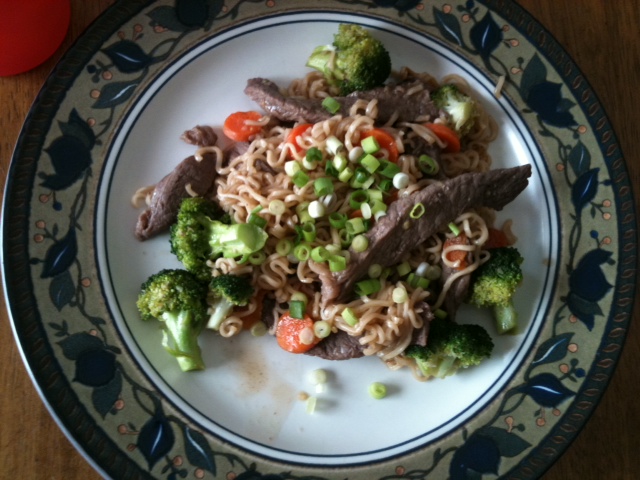
Healthy eating: Asian Beef Noodle

Ingredients

    • 2 T olive oil
    • 1 lb lean boneless beef top round steak – cut into 1/4 inch strips
    • 3 garlic cloves – pressed
    • 2 small pieces (1/2 inch) fresh ginger root, peeled and finely chopped
    • 2 cup water
    • ramen noodles, rice noodles or 1/2 spaghetti squash 
    • 3 cups broccoli florets
    • 2 carrots – sliced
    • 2 green onions – sliced
    • 2 tsp asian spice

Directions

  1. Heat olive oil in skillet over medium heat until hot. Stir fry beef, half at a time, 3-4 minutes, stirring until heated through. Set aside
  2. Add garlic and ginger to skillet, stir fry 30 seconds.
  3. Add water, bring to boil.
  4. Add noodles, broken into pieces, broccoli, carrots, and asian spices.
  5. Bring to boil, reduc heat. Simmer 3 minutes or until noodles are tender and most of the liquid is absorbed. Return beef to skillet, heat through.
  6. Sprinkle with green onions
Posted in Healthy Living | Tagged , , , | Leave a comment

The Greatest Love of All

This month we celebrate Valentine’s Day, the day to express our love to our significant other. At our church we hosted a Galentine’s event—to celebrate the relationships we have with the beautiful women around us.

At the event, we took a moment to and allow God to speak into a place that this month may painfully remind us of—rejection.

We’ve all experienced rejection in some way and so did the four women whose stories I told that night. Their stories demonstrate how God sees them and loves them when others rejected them.

Hagar’s Story

Hagar, the maidservant of Sarai, the wife of Abram experiences rejection through oppression and subjugation.

In Genesis, we’re told that God promises Abram a descendent, despite the fact that Sarai cannot have children. As he and Sarai wait and wait and wait for God to bring about the promise, they get a bit impatient and take the matter in their own hands.

Enter Hagar, Sarai’s maidservant who Sarai decides to give to Abram to have a child with. Hagar indeed gets pregnant and gives birth to Ishmael. This causes all kinds of problems between Sarai and Hagar, who is now Abram’s second wife.

Hagar runs away. But the Lord sees Hagar and he sends a messenger to her. She’s told to return home. She’s also told her son will be a great nation.

Hagar calls God El Roi – the God who sees me

And she calls the place where the messenger met her labeer lahia roi. The well of the Living One who sees.

God visits Hagar again after Sarah’s son Isaac is born and Sarah makes Abraham send Hagar and Ismael away into the desert. God finds Hagar weeping for she fears for her son’s life. God again reiterates his promise that Ishmael would be a great nation and Scripture says God was with the boy as he grew up.

God sees and loves you in the oppressive and unfair situations you may find yourself in.

Leah’s Story

Leah, the first wife of Jacob (Abraham’s and Sarah’s grandson), experiences rejection through deception.  

In Genesis we’re told Jacob is promised Rachel, Leah’s younger sister as a wife for seven years of labor.  However he’s tricked into marrying Leah first. He doesn’t love Leah—he loves Rachel—and he quickly marries Rachel for another seven years of labor.

This causes all kinds of problems between the two sisters. 

The Lord sees Leah is unloved and gives her children. There’s a bit of a pregnancy contest between Leah and Rachel (who at first cannot have children). They even include their maidservants to provide children for Jacob.

But we can see a hint of Leah’s transformation in the names she gives her sons.

  • The first son is Reuben – which means see a son. Leah says God has seen her affliction but she truly hopes her husband will now love her.
  • The second son is Simeon – which comes from to hear. Leah says God has heard she is unloved
  • The third son is Levi – which indicates attachment. Leah says at last her husband will be joined to her.
  • The fourth son is Judah – which means praise. Leah finally receives God’s love for her and praises him, despite her husband’s rejection. 

God sees and loves you in the places and relationships where you feel unloved.

Tamar’s Story

Tamar, the widow of two of Judah’s sons (who’s the fourth son of Jacob and Leah) experiences rejection through unkept promises.

In Genesis we’re told Tamar marries Judah’s eldest son Er and when he dies, she’s given to the second son Oman, who also dies. Judah is a bit concerned about giving her to his youngest son, Shelah—so he sends her back to her father’s home. Tamar expects to be given to his youngest son but she never is so she lives as a widow. Years go by. It becomes apparent that Judah has no intention of securing her place in the family by providing an heir for her neither through himself or his youngest, as tradition dictates. 

Judah visits the land where Tamar is now living. When she learns of his visit, she hatches a scheme. She pretends to be a prostitute, he hires her services, and unbeknownst to him, she gets pregnant. But she’s shrewd. She has a few of his items as pledge for payment, but he never pays her because she returns to her father’s house with his items.

When her pregnancy is discovered, Judah condemns her to death. But Tamar presents the items and declares the owner the father. Judah realizes he has not done what is right, but she has—so she is innocent. 

God does not speak in the story, but in a sense he sees her situation. Tamar’s place in the family is secured by the birth of not just one son, but two sons, Perez and Zerah. God has replaced the sons Judah lost and provided for Tamar in doing so.  

God sees you and loves you when you’ve been lied to and betrayed.

Ruth’s Story

Ruth, a foreigner and widow, refuses to experience rejection through separation.

In the book of Ruth we’re told that a family migrates to a foreign land because of a famine and there they take wives for their sons, Ruth being one of them. Sadly, the patriarch and his two sons both die, leaving three widows, all childless. The mother-in-law bitterly decides to return to her homeland and attempts to send her daughters-in-law back to their father’s houses. One goes back. The other, Ruth, refuses. She declares her love for Naomi, saying where you go I will go, and where you stay I will stay. Your people will be my people and your God my God.

In a series of bold events, Ruth seeks out the protection of a kinsman of her late husband, who just happens to be Boaz who is descended from Perez, the son of Judah and Tamar. He has the ability to secure Ruth’s future and the future of her widowed mother-in-law if he chooses. 

God does not speak however, Boaz tells Ruth may the Lord bless you for what you’ve done—which is her bold loyalty and devotion to Naomi. As the story progresses, Ruth boldly challenges him to be the one who fulfills that blessing. And he does so. He takes her as a wife and she gives him a son, Obed, who is the grandfather of the future King David.

God sees and loves you when in times you find yourself to be the outsider and the outcast.

Beautiful lovers of our Lord. Our God is the one who sees you, he provides for you, he protects you, he redeems you. 

He loves you with an everlasting love. So this month and every month, celebrate the greatest love of all, God’s love for each one of us.

Posted in Abundant Living | Tagged , , , , , , , | Leave a comment